
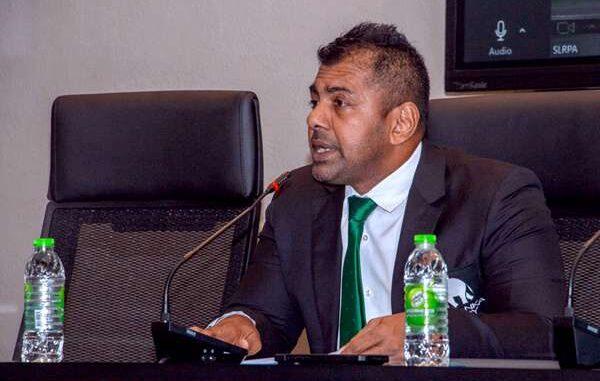
Sri Lanka Rugby (SLR) President Pavithra Fernando says that as an immediate interim measure, its Executive Committee (Ex-Co) has approved the sport’s local governing body to formally write to Asia Rugby (AR) to facilitate the appointment of two foreign match referees to officiate from the Super Round stage of the ongoing Maliban Inter-Club League Rugby Tournament.
He stated that this step has been taken to ensure neutrality and consistency during the decisive phase of the competition, to reduce unprecedented pressure on the existing local referee pool and to complement the longer-term referee development reforms.
It is learnt that the SLR has sought the AR’s input with its President Quais Al-Dhalai set to determine from which country the match officials will be flown down to Colombo.
Already, the ongoing Inter-Club League has been subjected to severe criticism by officials from competing clubs, past players, and spectators over what they perceive to be biased and sub-standard quality of officiating by most of those in the domestic referee pool.
A few key games have morphed into being the major talking point in local rugby firmament with certain decisions given by match officials being roundly criticised as being one-sided and some even calling into question their ability to interpret the laws efficiently due to poor language skills.
Meanwhile, the SLR Ex-CO has granted its conditional approval for the National Referee Development Plan while approving the SLR Elite Referee Panel subject to the securing of required sponsorship funding and subsequent ratification by the Council.
Fernando added that the plan has been developed to address the critical national shortage of qualified and competent match officials, which has been identified as one of the most significant challenges currently holding back the progress of Sri Lankan rugby.
The former national skipper emphasised that he has already sounded out past top notch referees of the caliber of S.W. Chang and Chula Dharmadasa to helm the proposed new referee committees.
Under the proposed plan, SLR is set to implement a one-time referee intake programme involving the development of 30 referee candidates comprising 15 referees nominated from the tri-forces (Sri Lanka Army, Navy, and Air Force).
It is to be arranged by the Sri Lanka Rugby Foundation Chairperson (Retd.) Group Captain Nalin de Silva, Defence Secretary Vice Air Marshall (Retd.) Sampath Thuyakunatha, and 15 referees recruited through an open national advertisement, targeting former and recently retired players and individuals with solid game understanding.
All selected candidates will undergo a uniform Sri Lanka Rugby-led training, assessment and accreditation pathway, aligned with World Rugby (WR) best practice.
Fernando reiterated that this intake is a one-time intervention, introduced solely to address the existing shortfall in match officials.
The SLR head observed that the elite referee panel will function under a centralised referee management model, whereby referees officiating elite and national competition will be appointed by SLR, centrally monitored and performance-assessed and subject to standardised grading, mentoring, and review processes.
This governance model aligns SLR with global best practice adopted by the majority of leading rugby nations, where national governing bodies directly manage elite referees to guarantee neutrality, consistency and match integrity.
The SLR has also placed on record its sincere appreciation to the Sri Lanka Society of Rugby Football Referees (SLSRFR) for its long-standing service and contribution to rugby officiating here.
The EX-Co has recognised the dedication and commitment of generations of referees and administrators under the Society and reaffirmed the SLSRFR will continue to be a valued partner in grassroots recruitment, referee education, mentoring, and development under the new framework.
The SLR insists that they will continue structured engagement with referees’ societies, stakeholders, and regional partners during this period.
The controlling body also stressed that these measures constitute a governance and integrity reform, aimed at improving officiating standards, enhancing player and official safety, and restoring trust in domestic competitions.
Be the first to comment