

By Hishan Welmilla
Wanindu Hasaranga’s bizarre dismissal against England has once again brought an unusual question into focus: why are Sri Lankan batsmen being dismissed hit-wicket with such surprising frequency?
At first glance, there is nothing particularly sinister about a batter being dismissed in this manner. Hit-wicket is one of the recognised modes of dismissal in cricket, and the circumstances can often be nothing more than an unfortunate combination of footwork, balance, shot selection and follow-through.
But when an extremely rare form of dismissal keeps appearing in the records of the same team, it is reasonable to ask whether there is something worth examining more closely.
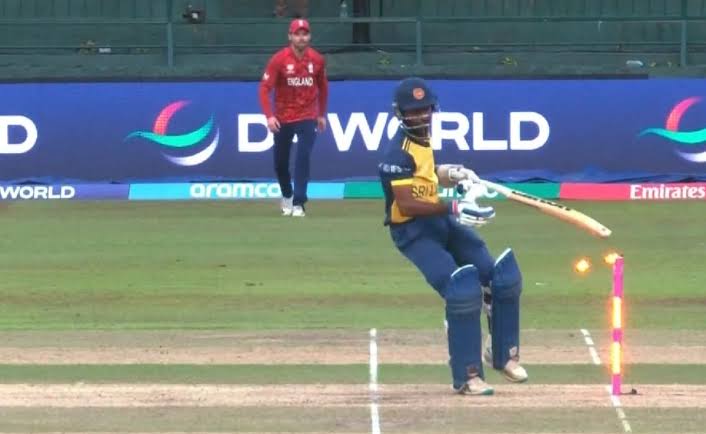
Hasaranga’s dismissal in the third T20I against England at Emirates Old Trafford on September 19 was an extraordinary example. Having scored seven runs from six deliveries, he attempted a swipe at Jofra Archer. He missed the ball and could not control the follow-through of his bat, which went around his waist and flicked the bails from the stumps. He immediately realised what had happened and walked away.
On its own, it was simply one of cricket’s strangest dismissals.
But the wider statistics tell a more intriguing story.
Since January 2023, there have been only 15 hit-wicket dismissals involving the 12 ICC Full Member nations across Test, ODI and T20I cricket, according to the available compilation. Sri Lanka account for five of those 15 dismissals — exactly one-third of the total. Afghanistan, Pakistan and Zimbabwe have recorded two each, while Australia, Bangladesh, India and the West Indies have one apiece. England, Ireland, New Zealand and South Africa have recorded none during the period.
More strikingly, Sri Lanka’s five dismissals involve five different players.
Sri Lanka’s five cases
In February 2024, Angelo Mathews was dismissed hit-wicket for 141 against Afghanistan in a Test.
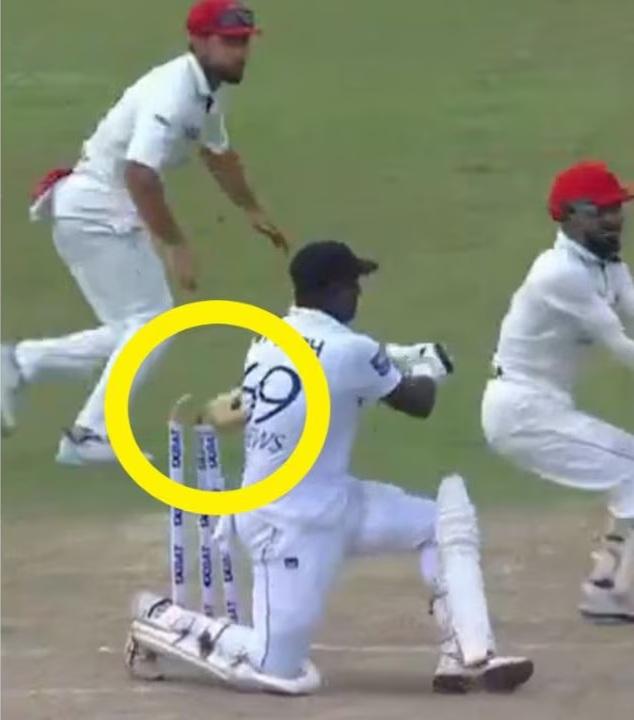
Later that month, Sadeera Samarawickrama was dismissed in the same fashion for 51 in a T20I against Afghanistan.
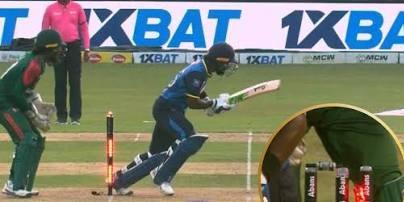
In July 2025, Janith Liyanage became the third Sri Lankan victim when he was dismissed for 12 against Bangladesh in an ODI, after his bat contacted the stumps while he was moving backwards.
Then came 2026.
During the T20 World Cup Super Eight match against England at Pallekele on February 22, Dushan Hemantha was dismissed hit-wicket for five. The incident added another extraordinary chapter to Sri Lanka’s growing list of unusual dismissals.
Seven months later, Hasaranga became the fifth Sri Lankan victim — and the second Sri Lankan to suffer a hit-wicket dismissal against England in 2026.
That creates an unusual statistical cluster.
However, there is an important statistical question that should not be overlooked.
Five out of 15 sounds dramatic — but how many innings did each country play during the same period?
Sri Lanka’s international workload, number of matches and number of deliveries faced must be considered before concluding that Sri Lanka have an unusually high rate of hit-wicket dismissals. A team playing more cricket naturally has more opportunities to produce a rare event.
Therefore, the next stage of the analysis should be to calculate hit-wicket dismissals per 1,000 innings or per 100,000 deliveries faced, rather than relying solely on the raw number.
That would tell us whether Sri Lanka are genuinely an outlier or whether the apparent concentration is partly a consequence of exposure.
There is another important question: does the pattern vary by format?
Test cricket, ODI cricket and T20 cricket demand very different batting movements. Modern T20 batting, in particular, involves bigger swings, unconventional shots, deep movements in the crease and aggressive follow-throughs. These techniques may naturally create situations in which a batter is more likely to make contact with his own stumps.
Hasaranga’s dismissal is a good example. The available commentary describes him getting beaten by a back-of-a-length delivery outside off before his uncontrolled follow-through carried the bat into the stumps.
So perhaps the more constructive question is not whether something improper is happening, but whether there is a technical pattern worth studying.
A frame-by-frame review of all five Sri Lankan dismissals could examine:
Where the batter was positioned in the crease; Whether the batter was moving forward or backwards;The type and length of delivery;The shot attempted;
Whether the stumps were struck by the bat, foot or body;The direction of the follow-through;Whether the batter was under particular pressure at the time.
If several of these incidents show similar movements, coaches and performance analysts may have something useful to work with.
There is also a case for examining Sri Lanka’s domestic cricket.
If similar dismissals are occurring regularly at domestic level, the issue could potentially be related to batting technique, coaching methods or training practices. If the pattern appears almost exclusively in international cricket, the explanation may be very different.
Statistics alone, however, do not establish wrongdoing.
There is no evidence in these five incidents that they were connected to match-fixing, corruption or deliberate misconduct. A statistical concentration, particularly within a relatively small sample, should not be presented as evidence of corruption.
At the same time, an unusual statistical pattern should not automatically be dismissed simply because every individual incident has an understandable cricketing explanation.
That is precisely what statistics are supposed to do: identify something unusual and invite a deeper question.
Five hit-wicket dismissals among only 15 recorded across the 12 Full Members since January 2023 is certainly unusual. But whether it remains unusual after adjusting for matches played, innings and balls faced is the question that requires further investigation.
And perhaps that is where the real story lies.
Are these simply five bizarre moments of cricketing misfortune?
Is Sri Lanka’s aggressive batting style creating a greater risk of hit-wicket dismissals?
Is there a recurring technical flaw in footwork or follow-through that coaches should address?
Or, after all the numbers are properly adjusted, will the pattern disappear into the statistics as nothing more than an unusual coincidence?
Those questions can be examined without making accusations.
For now, the evidence establishes only this: Sri Lanka have recorded five of the 15 hit-wicket dismissals among the ICC Full Members since January 2023.
That is an unusual statistic.
But unusual statistics are not conclusions.
They are invitations to investigate.
Sometimes, numbers do not provide the answer. They simply tell us which questions are worth asking.
Open for discussion.
Be the first to comment