

By Hishan Welmilla
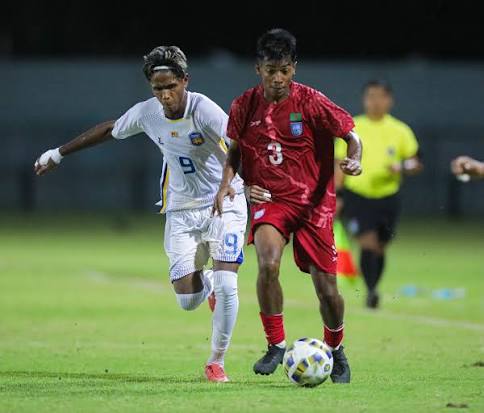
Sri Lanka’s 4-0 defeat to Bangladesh was disappointing enough. But what followed the match has raised even more serious questions about the state of football administration in South Asia, the transparency of the regional governing body and the future of Sri Lankan football.
The controversial remarks made by Sri Lanka head coach Abdullah Al Mutairi at the post-match press conference have brought an entirely different dimension to the situation.
His allegations against the South Asian Football Federation (SAFF) raise important questions about fairness, accountability and the treatment of coaches within the regional football structure.
A Mysterious Midnight Email Before the Match!
According to Al Mutairi, he received an email from SAFF around midnight on the eve of the match, demanding an explanation within just 10 hours. He claimed that the communication threatened him with a six-month suspension and a fine of US$10,000 if he failed to respond within the stipulated period.
If these allegations are accurate, serious questions must be asked.
Is it appropriate for a regional governing body to issue such a demanding disciplinary communication just hours before an important international fixture? Could such an intervention affect a coach’s mental preparation and, indirectly, the team’s performance?
The issue is not simply whether a disciplinary complaint existed, but whether the procedure followed was fair, transparent and consistent with established regulations.
Are Arab Coaches Being Treated Differently?
Al Mutairi has made an even more serious allegation, claiming that Arab coaches and nationals face discrimination and double standards within SAFF.
He also referred to his experience in 2021, when he guided Nepal to the SAFF Championship final, claiming that he encountered similar unfair treatment during that campaign.
These are serious allegations that cannot simply be dismissed as emotional reactions following a disappointing result.
However, allegations alone are not proof. They must be examined through an independent and transparent investigation. SAFF must have an opportunity to respond, while Al Mutairi should provide the evidence he says is in his possession.

What Does This Mean for Sri Lankan Football?
Perhaps the most unfortunate aspect of this controversy is that the team’s actual performance against Bangladesh risks being overshadowed by the dispute between the coach and the regional governing body.
A 4-0 defeat demands serious questions about Sri Lanka’s football development and the team’s preparation.
Why did Sri Lanka’s game plan fail so comprehensively?
Why was the defensive structure so vulnerable?
Were the coach’s tactical decisions appropriate for the opposition?
Did the players execute the required game plan?
What responsibility should the football administration take for the team’s continuing struggles?
These questions deserve proper answers. It would be unfortunate if the entire discussion surrounding Sri Lankan football became centred on a controversy with SAFF while the fundamental problems affecting the national team remained unaddressed.
“I Will Never Return to the SAFF Region!”
Al Mutairi has reportedly declared that he will never again coach in the SAFF region. He has also indicated that he intends to make public the evidence and email correspondence he claims to possess.
That is ultimately his personal decision. However, for a country such as Sri Lanka, which is attempting to rebuild its position in international football, the consequences of this controversy cannot be ignored.
The future of the national team should not become collateral damage in a personal or administrative dispute.
At the same time, if a coach representing Sri Lanka has been subjected to unfair treatment, the country’s football authorities have a responsibility to seek clarification and demand accountability.
Silence cannot be the answer.
What Sri Lankan Football Needs Now Is Accountability, Not Excuses!
SAFF must respond officially to the allegations. Al Mutairi must provide the evidence he has promised to disclose. The Sri Lanka Football Federation must also explain its position and clarify what steps, if any, it has taken to address the matter.
But above everything else, Sri Lankan football needs to confront its sporting failures.
What the country needs is not a coach engaged in endless disputes with SAFF, but a coach capable of taking the national team towards international success. Similarly, Sri Lanka needs football administrators who accept responsibility for defeats, address structural weaknesses and work towards rebuilding the game rather than relying on excuses and promises.
Ultimately, the 4-0 defeat to Bangladesh should serve as a wake-up call.
The controversy surrounding Al Mutairi may eventually fade, but the problems confronting Sri Lankan football will remain unless decisive action is taken.
Sri Lankan football needs more than promises. It needs answers, accountability and meaningful change!
Be the first to comment