
by Hishan Welmilla
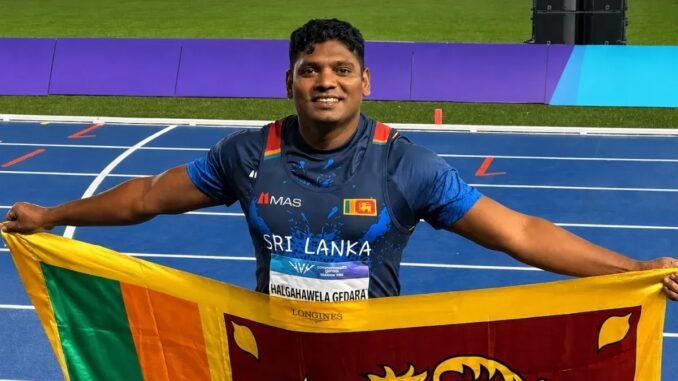
Sri Lanka’s para-athletes once again demonstrated remarkable resilience and world-class talent at the 2026 Commonwealth Games, delivering performances that deserve both national pride and urgent attention. Among the standout achievements was Palitha Bandara, who secured a historic silver medal in the men’s discus throw F42-44/F61-64 event. Bandara produced a powerful and technically sound throw of 46.84 metres in the final, firmly establishing himself among the elite para-athletes in the Commonwealth. His performance was not only a personal triumph but also a testament to the untapped potential that exists within Sri Lanka’s para-sports community when given even minimal support.
Equally inspiring was the effort of Janani Dhananjana in the women’s T47 100m event. Though she narrowly missed out on a bronze medal by a mere 0.04 seconds, her timing of 12.50 seconds marked a new personal best — an achievement that underscores her rapid progress and determination on the international stage. Missing a podium finish by such a slim margin is undoubtedly heartbreaking, yet her performance sends a powerful message: Sri Lanka possesses athletes who are capable of competing with the very best in the world. Both Bandara and Dhananjana have elevated the country’s reputation in para-sports through sheer dedication, often in the face of significant challenges.
However, these achievements also bring into sharp focus a long-standing concern — the inadequate support, recognition, and infrastructure provided to para-athletes in Sri Lanka. Despite their success and the pride they bring to the nation, the level of care and investment from the Ministry of Sports and relevant authorities remains far below what is required. Unlike able-bodied athletes, para-athletes frequently struggle with limited access to specialized training facilities, insufficient financial assistance, lack of modern equipment, and minimal exposure to international competitions. This disparity not only affects performance outcomes but also discourages many talented individuals from pursuing sports at a professional level.
To truly harness the potential of para-athletes, Sri Lanka must adopt a more inclusive and equitable approach to sports development. First and foremost, there must be a structured national program dedicated to para-sports, with clearly defined pathways for athlete identification, training, and progression. Specialized coaching is essential, as para-athletes require tailored training techniques that address their unique physical conditions. Investing in qualified coaches, physiotherapists, and sports scientists with expertise in para-athletics would significantly enhance performance standards.

Infrastructure development is another critical area. Training facilities must be upgraded to ensure accessibility and inclusivity, including adaptive equipment and safe training environments. High-performance centers should cater equally to para-athletes, providing them with the same level of resources available to able-bodied counterparts. Additionally, access to advanced sports technology, such as biomechanical analysis and recovery systems, can play a pivotal role in improving competitive outcomes.
Financial support remains a key concern. Many para-athletes rely on personal funding or limited sponsorships to sustain their careers. Establishing a dedicated funding mechanism — including government grants, corporate sponsorship programs, and performance-based incentives — would provide athletes with the stability needed to focus entirely on their training. Furthermore, offering employment opportunities and educational support would ensure long-term security for athletes beyond their sporting careers.
Equally important is the need for greater recognition and media coverage. Celebrating para-athletes’ achievements on national platforms not only boosts morale but also inspires future generations. Public awareness campaigns can help change societal perceptions and foster a culture that values inclusivity and equal opportunity in sports. Schools and community programs should also encourage participation in para-sports, identifying talent from an early stage and nurturing it through structured development systems.
The performances of Palitha Bandara and Janani Dhananjana at the 2026 Commonwealth Games are not isolated successes — they are indicators of what Sri Lanka can achieve with the right support system in place. Their determination, discipline, and courage have already placed the nation on the global map in para-athletics. What is needed now is a collective commitment from policymakers, sports authorities, and the private sector to bridge the existing gaps and provide para-athletes with the resources they rightfully deserve.
If Sri Lanka is to emerge as a competitive force in global para-sports, the time to act is now. By investing in infrastructure, expertise, and athlete welfare, the country can transform these inspiring individual performances into sustained international success. Para-athletes have proven that their potential knows no limits — it is up to the nation to ensure that their opportunities are equally boundless.
Be the first to comment