
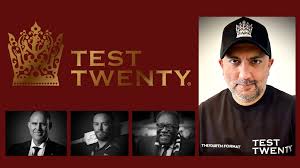
A new global vision for cricket
A bold new chapter is unfolding in cricket’s evolution, with the unveiling of Test Twenty — a hybrid format that blends the intensity of T20 with the strategic depth of Test cricket. The new format is being pitched as cricket’s fourth official format, following Tests, ODIs, and T20Is, and is set to debut in January 2026.
Developed by sports entrepreneur Gaurav Bahirvani, Executive Chairman of The One One Six Network, Test Twenty has already attracted high-profile support from some of the game’s most respected voices, including AB de Villiers, Harbhajan Singh, Sir Clive Lloyd, and Matthew Hayden — all of whom are part of the advisory board.
Inside the Test Twenty format
Test Twenty matches will be played across 80 overs, with each team batting twice for 20 overs, similar to a two-innings Test match. The key innovation is that scores carry forward between innings, and all traditional results — win, loss, tie, or draw — are possible.
Designed for single-day completion, the format aims to combine the tactical layers of Test cricket with the pace and accessibility of the shorter game — making it ideal for modern audiences and broadcasters.
Global scouting powered by AI
At the heart of Test Twenty is an AI Discovery Engine, which uses video analysis, motion-sensor technology, and data science to assess talent. Through Tech-Transfer Partnerships (TTP), this tool will be made available to cricket boards, academies, and associations worldwide to identify players with objectivity and transparency.
A league for the next generation
Test Twenty is targeting the 13–19 age group as its core audience and participant base, aiming to both entertain and inspire the next wave of cricketers. The inaugural season will feature six global franchises, including three Indian teams and three international teams representing Dubai, London, and the United States. Each squad will comprise 16 players, evenly split between Indian and international cricketers.
As part of its youth-first approach, the league will offer free entry for teenagers aged 13–19, requiring only an ID for access. “We will fill the stadiums. It will take time. But we will do so,” said Bahirvani.
India first — but with a touring ambition
The format will launch in India, with plans to host the first two seasons domestically before expanding into international markets.
“I think for us it was very obvious that we launched this in our country, which has the biggest eyeballs when it comes to cricket. So we’re launching this in India. We’re going to play in India for a couple of years, and the idea is to make it a touring league. We eventually want to take it to different countries. The reason for that is also that I’m very interested in non-traditional nations to step in. I want kids from those countries to also pick up cricket as an opportunity as a sport like we do in India,” said Gaurav while replying to a Hindustan Times query during a select media interaction.
“You know we never knew about rugby or basketball for a very, very long time, till you know the opportunity came through the internet, and we started playing that game in India. It’s the same thing we want to take cricket to those nations as well, and given the fact that if it becomes a touring league, the youngsters will also experience the opportunity of travelling outside, just like how these great legends have travelled in their entire lives playing in different countries, and I think that experience is very important as well. So yes, to answer the question, we will be launching in India and we’ll be playing in India for the first couple of years,” he added.
Backing from cricketing greats
Several legends have voiced their strong support for the Test Twenty vision:
“Test Twenty is innovation with intent — it honours the traditions of the game while embracing the possibilities of the future. It gives young players a new dream to chase and fans a new story to follow,” said AB de Villiers.
“As a player and a parent, I see this as cricket’s bridge between eras — a format that carries the wisdom of the old world into the fire of the new. For young players, this is a chance to grow not just as athletes, but as people,” said Matthew Hayden.
“Cricket needed a fresh heartbeat — something that connects today’s youth with the game’s original spirit. Test Twenty does exactly that,” said Harbhajan Singh.
Saving Test cricket, not replacing it
For Sir Clive Lloyd, this new initiative isn’t about replacing Test cricket — it’s about reviving its values in a modern form, especially for nations like the West Indies, where traditional cricket structures are under strain.
“Having lived through every era of cricket, I can say this — the game has always adapted, but never this thoughtfully. Test Twenty brings back the art and rhythm of the sport, yet keeps it alive with modern energy,” said Sir Clive Lloyd.
“The point is that I am a Test cricket person. There is no doubt about that. I believe that we have neglected Test cricket over the years, and I think it’s time to reintroduce it into the system. Because really, truly, I find it very difficult to assess you as a top cricketer or a first-class cricketer or a Test cricketer. If you have played to the highest level. And as I said earlier, it’s an examination,” added Lloyd.
“It examines every part of your cricketing skills. And I don’t want to see the end of Test cricket. I think it would be a tragedy if we don’t want to continue in this vein. And I would like to ask, do we have the ICC’s backing? Do we have the countries backing this? Because it will be a help to them. Because I know that we are struggling with monitoring in the West Indies. Because it’s a very difficult situation for us. 14 islands, just 5 million people. And if we don’t have the finances to look after our cricket, we will be in the doldrums for quite a while. So I want to see Test cricket backed. So that’s why I want to back this system,” he concluded.
Looking ahead
With its launch set for early 2026, Test Twenty aims to offer something entirely new — not only as a competition but as a development platform, global scouting network, and a cultural bridge between traditional cricket and future audiences.
Its success will hinge on execution, adoption by the cricket ecosystem, and whether it can deliver on its promise: to revive the spirit of Test cricket while reshaping it for a new generation.
Be the first to comment