
Sri Lanka’s hopes of making a strong statement in Test cricket have suffered another setback after Pakistan clinched the two-match Test series 1-0, leaving the islanders to reflect on what could have been a much better campaign.
For a team with a proud Test cricket tradition, the series defeat is more than just a disappointing result. It raises questions about consistency, the ability to perform under pressure and the team’s capacity to turn promising situations into match-winning performances.
A drawn opening Test had offered Sri Lanka an opportunity to keep the series alive and challenge Pakistan in their own backyard. However, the defeat in the decisive encounter ultimately handed the hosts the series advantage.
The second Test in Rawalpindi exposed Sri Lanka’s biggest weakness in the series – their inability to cope with Pakistan’s disciplined bowling attack when it mattered most.
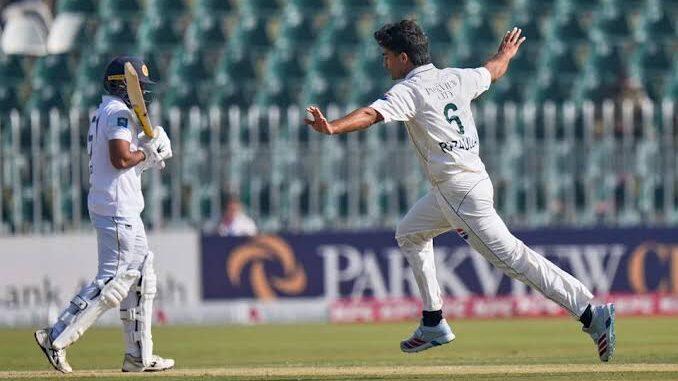
Sri Lanka suffered a disastrous start after being sent in to bat, collapsing to just 98 runs in their first innings in 35.3 overs. Mohammad Abbas, Aamer Jamal and Razaullah shared the damage, while the Sri Lankan batting line-up failed to offer meaningful resistance. It was a performance that put the visitors firmly on the back foot from the outset.
Pakistan responded with 325 runs, securing a commanding first-innings lead of 227 runs. Although Lahiru Kumara produced an impressive bowling performance, claiming five wickets, Sri Lanka had already given their opponents a substantial advantage.
To their credit, the Sri Lankan batters showed considerably more determination in the second innings. Kusal Mendis (53), Sonal Dinusha (54) and Milan Rathnayake (66 not out) scored half-centuries, helping Sri Lanka reach 316. Their effort gave the visitors some respectability and demonstrated that the batting unit was capable of a much better performance.
However, the damage inflicted in the first innings proved too costly. Pakistan were left with a modest target of just 90 runs and comfortably reached 90 for two, winning the Test by eight wickets and sealing the series 1-0.
The contrast between the two innings was particularly disappointing for Sri Lanka. A team that managed only 98 in its first attempt showed considerably greater application in the second. That inconsistency remains a major concern for a side aspiring to establish itself among the leading Test teams.
There were encouraging individual performances during the series. Dhananjaya de Silva’s magnificent 167 and Kusal Mendis’ 119 in the opening Test demonstrated Sri Lanka’s batting potential. Their first-innings effort of 446 had even given Sri Lanka a slender 12-run lead over Pakistan’s 434 for nine declared. But Pakistan’s determination in the second innings, particularly Saud Shakeel’s 97, ensured the opening encounter ended in a draw.
Ultimately, Pakistan proved the more consistent and better-prepared side when the series was on the line.
For Sri Lanka, the 1-0 defeat should serve as a wake-up call. The team has the individual talent to compete at the highest level, but talent alone cannot win Test matches. Greater responsibility from the top order, improved concentration and the ability to withstand pressure over five days are essential.
The disappointment in Rawalpindi is another reminder that Sri Lanka must rediscover the consistency and fighting spirit that once made them a formidable force in Test cricket.
The series may have ended 1-0, but the questions surrounding Sri Lanka’s Test cricket future remain much bigger than the margin of defeat.
Be the first to comment