
By Hishan Welmilla
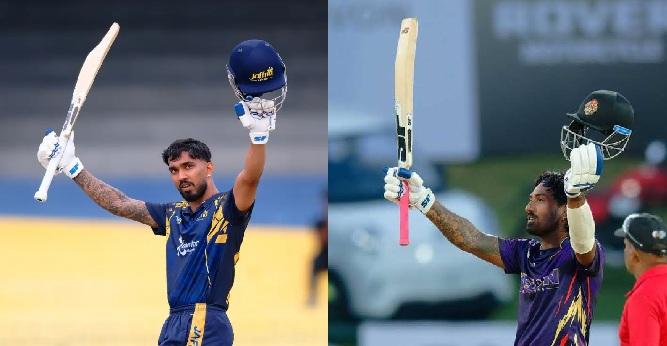
The recently concluded Lanka Premier League once again highlighted Sri Lanka’s growing pool of exciting batting talent. Among the players who attracted considerable attention were Lahiru Udara and Kamil Mishara. Both produced impressive performances in the T20 competition and appeared to have strengthened their claims for opportunities at international level. However, their introduction to Test cricket against India produced a much more modest return, raising an important question for Sri Lankan cricket: does success in T20 cricket automatically indicate readiness for the five-day game?
The answer, perhaps unsurprisingly, is no.
Udara’s LPL campaign was particularly impressive. He finished the tournament with 434 runs in nine innings at an average of 54.25 and a strike rate of 159.56, including a century. Mishara was equally influential, scoring 411 runs at an average of 51.38 and a strike rate of 165.06. His consistency and aggressive approach earned him Player of the Tournament recognition.
Those performances naturally created expectations when both players were given opportunities in Test cricket. But Test cricket immediately presented a completely different challenge.
Udara played two Tests against India and scored 27 and 16 in the first match before recording scores of one and three in his other two innings. Mishara, who played one Test, scored 19 and 32. On paper, these numbers are disappointing compared with the standards they had established in the LPL.
Yet judging either player solely on these innings would be unfair.
The first point Sri Lankan selectors and supporters must understand is that T20 success and Test success are based on overlapping but fundamentally different skill sets. A player can possess excellent hand-eye coordination, power, confidence and the ability to score rapidly without necessarily having the technique or temperament required to bat for two or three hours in a Test innings.
In T20 cricket, a batter knows that opportunities to score are limited. The pressure is therefore often directed towards attacking the bowler. In Test cricket, the challenge is almost reversed. The batsman must be comfortable leaving the ball, defending repeatedly, absorbing periods of pressure and waiting patiently for scoring opportunities.
For an opener, the difference is even greater.
The opening batsman in Test cricket must face the new ball when conditions are most favourable to the fast bowlers. Movement through the air, seam movement off the pitch and consistent bowling around the off stump can expose even technically accomplished players. A batter accustomed to attacking from the first over may have to completely change his mindset.
This is where Udara and Mishara need to develop.
Their attacking ability should not be taken away from them. In fact, that ability could eventually become a major advantage in Test cricket. Modern Test cricket increasingly rewards batsmen who can change the tempo of an innings. The key is learning when to attack rather than simply how to attack.
Shot selection will be particularly important. A player may be able to hit a particular delivery for six in T20 cricket, but attempting the same shot against a quality Test bowler with a slip cordon waiting can result in an inexpensive dismissal. Test cricket demands a greater understanding of risk.
Defence is another area that cannot be overlooked. A Test batsman needs confidence in his defensive technique. He must know which deliveries to leave, which to defend and which to attack. The ability to survive a difficult 30-ball spell can sometimes be more valuable than scoring 30 runs quickly.
There is also a significant mental difference.
In T20 cricket, a failure can be quickly forgotten because another match arrives within days. In Test cricket, a batsman may spend an entire session thinking about a mistake. Concentration has to be maintained for long periods, and the ability to reset mentally after a dismissal or a difficult passage is critical.
However, there is encouraging evidence that neither Udara nor Mishara should be considered purely white-ball specialists.
Udara has considerable experience in domestic first-class cricket and has already demonstrated the ability to produce substantial innings in the longer format. Mishara, too, has shown that he can construct big scores outside T20 cricket. That background suggests that their LPL performances were not simply isolated examples of players suited only to the shortest format.
What they now need is a carefully managed transition.
Instead of expecting immediate Test success because of an outstanding LPL campaign, Sri Lanka should give these players time to understand international red-ball cricket. They need exposure to quality pace bowling, demanding Test conditions and long periods at the crease. Their technical weaknesses should be identified and addressed through domestic first-class cricket and specialised preparation.
The selectors also need to be careful about how expectations are created. A successful LPL campaign should earn a player an opportunity, but it should not automatically create the expectation that he will reproduce a strike rate of 150 in Test cricket.
The objective is completely different.
For Udara and Mishara, success in Test cricket may initially mean scoring 40 after spending two hours at the crease rather than scoring 40 from 25 balls. Later, that foundation can develop into bigger hundreds. The ability to change gears should become an additional weapon rather than the basis of their entire game.
Their recent scores should therefore be viewed as a lesson rather than a verdict.
Sri Lanka needs players capable of succeeding across formats, but becoming a successful Test batsman is a process that cannot be rushed. The LPL can provide confidence, exposure and recognition, but Test cricket demands patience, discipline, technique and mental resilience.
Udara and Mishara have already shown that they possess talent. Their next challenge is to prove that their talent can survive when the game slows down.
If they can learn to combine the aggression that made them LPL stars with the patience and discipline demanded by Test cricket, their disappointing beginnings could eventually become an important chapter in the development of two valuable Sri Lankan batsmen.
The real question, therefore, is not whether they failed after the LPL.
It is whether Sri Lanka gives them the opportunity, coaching and time required to learn how to succeed in a completely different game.
Be the first to comment