
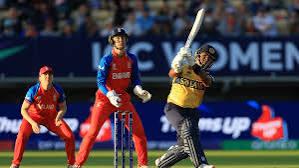
By Leonard Ratnayake
Having conceded a mammoth 222 runs in 20 overs, Sri Lanka were always facing a daunting task in their chase. The challenge became even steeper when they lost two early wickets, with key batters Vishmi Gunaratne and captain Chamari Athapaththu both dismissed before reaching double figures.
Despite the early setbacks, vice-captain Harshitha Samarawickrama produced an encouraging innings and looked set to anchor the chase. She played with confidence and intent, finding the gaps regularly and showing positive strokeplay before her promising knock was cut short for 29. Her innings briefly raised hopes of a competitive response from Sri Lanka.
Thereafter, wickets continued to fall at regular intervals, making it difficult for Sri Lanka to build meaningful partnerships. However, there were several positives to take from the batting effort. Nilakshika de Silva contributed a fighting 39, while Kavisha Dilhari added a valuable 19, both displaying composure against a strong English bowling attack.
Although the target ultimately proved beyond reach, Sri Lanka’s batters showed noticeable improvement against quality opposition. Their strokeplay was often convincing, and they demonstrated a willingness to take on the bowlers. However, the required run rate continued to climb, and the loss of wickets at crucial moments prevented them from mounting a serious challenge.
Sri Lanka eventually finished on 132 all out, handing England an 87-run victory in the opening match of the ICC Women’s World Cup at Edgbaston.
Earlier, England had laid down an early marker in the tournament, posting a formidable 222 for 1 after being asked to bat first.
The day began with concerns over the weather, as heavy rain and gloomy overcast conditions threatened to disrupt the much-anticipated opening encounter. However, contrary to forecasts that predicted unsettled weather well into the afternoon, the skies gradually cleared to reveal bright sunshine, providing ideal conditions for cricket.
Having won the toss, Sri Lanka elected to bowl first, a decision largely influenced by their successful run chases in both warm-up matches leading into the tournament. Yet their plans were disrupted before a ball was bowled, as a delay caused by a sightscreen visibility issue pushed back the start of play.
The interruption appeared to affect Sri Lanka more than England. With time lost before the start, the fielding side found themselves under pressure to maintain the over rate, forcing frequent bowling changes. Even after ten overs, Sri Lanka remained six minutes behind the required rate.
England’s opening pair took full advantage of a lacklustre Sri Lankan bowling performance. The bowlers struggled to find consistency in line and length, allowing the English batters to score freely from the outset. England raced along at nearly ten runs an over during the powerplay, placing immediate pressure on the Sri Lankan attack.
Sri Lanka’s troubles were compounded by missed opportunities in the field. Amy Jones, in particular, enjoyed two crucial lifelines. The wicketkeeper-batter was first dropped near the square-leg boundary off a delivery from Chamari Athapaththu before Sugandika Kumari failed to hold onto a difficult return catch. Those missed chances proved costly as Jones capitalised on the reprieves.
The breakthrough finally arrived in the 14th over when young pacer Malki Madara provided Sri Lanka with a much-needed success. This time Jones failed to make the most of a third opportunity, and Athapaththu completed the catch to end a damaging opening partnership. By then, however, England had already surged to 135 for 1.
Jones’ aggressive knock of 53 from just 38 deliveries laid the foundation for England’s imposing total. At the other end, Danni Wyatt-Hodge produced a superb innings, combining power with precision to dominate the Sri Lankan bowlers. She brought up a magnificent unbeaten century, finishing on 101 not out from 61 balls and ensuring England never lost momentum.
Despite rotating their bowlers in search of breakthroughs, Sri Lanka were unable to stem the flow of runs or build any sustained pressure after the lone wicket. England closed on a commanding 222 for 1, a total that ultimately proved far beyond Sri Lanka’s reach.
Be the first to comment