
By Leonard Ratnayake
Missed semi-final berth costs Sri Lanka women cricketers USD 675,000, but World Cup campaign offers hope for the future
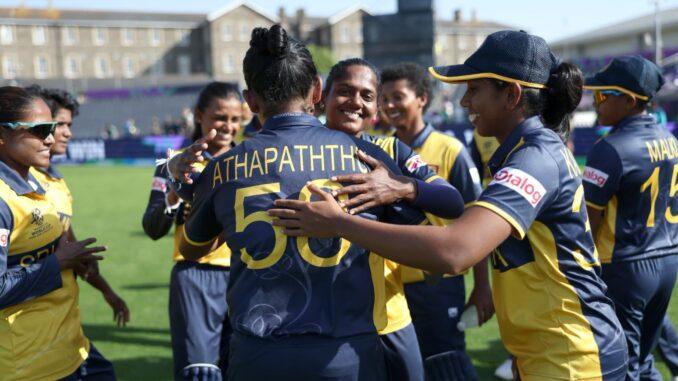
Sri Lanka Women’s spirited campaign at the 2026 ICC Women’s T20 World Cup in England ended in disappointment, falling just short of a coveted semi-final berth. Missing out on the last four not only denied them a place among the world’s elite but also cost the team a lucrative prize of USD 675,000 (approximately Rs. 226 million), a financial reward that could have transformed the lives of many players.
Yet, despite the heartbreak, there was plenty to admire. Winning three of their five group matches was a significant achievement for a relatively young Sri Lankan side. More importantly, their semi-final hopes remained alive until the final round of group matches, reflecting the progress the team has made over the past few years and providing encouraging signs for the future.
Sri Lanka’s campaign began with a harsh reality check against tournament hosts England. The experienced English side exposed several weaknesses that Sri Lanka perhaps believed had already been addressed.
The bowling attack lacked discipline, leaking runs throughout the innings, while the fielding was well below international standards. Misfields, dropped catches and poor execution in the field handed England valuable extra runs. Equally disappointing was the failure of the opening batters, who had looked promising during the warm-up matches but failed to carry that form into the tournament proper.
Fighting back against New Zealand
Sri Lanka produced one of their finest performances to defeat New Zealand, reviving hopes of reaching the semi-finals. It was a victory built on determination and resilience rather than complete domination.
However, the success could not completely mask the team’s batting concerns. Once again, the top order struggled to establish a solid platform. Nilakshika Silva once again carried much of the batting responsibility, producing another composed innings when the team needed stability.
While the victory restored confidence, Sri Lanka still had not solved their recurring top-order batting issues.
Unfortunately, having to face England, New Zealand and West Indies in their opening three matches left very little room for error or time to recover from early setbacks. Against the Caribbean side, Sri Lanka’s batting completely collapsed as they managed only 98 runs, a total that was never going to trouble an experienced opposition.
That defeat would ultimately prove decisive in ending Sri Lanka’s hopes of progressing further.
Chamari Athapaththu – The team’s greatest strength and biggest dependency
No player carries greater expectations than captain Chamari Atapattu.
Sri Lanka’s fortunes continue to depend heavily on her performances with the bat, and that dependence was once again evident throughout the tournament.
Her magnificent century against Ireland in Bristol remains one of the highlights of Sri Lanka’s campaign and almost single-handedly kept their World Cup hopes alive. Yet, outside that innings, Athapaththu struggled to produce the consistent match-winning contributions expected of one of world cricket’s finest all-rounders.
When Athapaththu fails with the bat, Sri Lanka often struggle to post competitive totals. This tournament once again highlighted the urgent need for greater batting support from the rest of the top order. Her bowling too lacked its usual effectiveness, denying Sri Lanka another important weapon.
One of the biggest disappointments was the inability of Sri Lanka’s top order to consistently provide solid starts.
Opener Vishmi Gunaratne never found her rhythm during the tournament despite encouraging performances in the warm-up matches. Following the defeat to West Indies, she eventually lost her place in the side after a series of low scores.
Vice-captain Harshitha Samarawickrama repeatedly showed glimpses of her immense talent, getting herself into promising positions before failing to convert starts into substantial innings. At this level, starts alone are insufficient. Building innings and finishing matches are qualities Sri Lanka desperately needed from one of their senior batters.
Captaincy under scrutiny
While Atapattu remains Sri Lanka’s greatest ambassador for women’s cricket, this tournament also exposed certain shortcomings in her leadership.
Managing an inexperienced bowling attack is never easy, but there were occasions where bowling changes appeared reactive rather than proactive. The bowlers were often left under pressure for extended periods while opposition batters dictated the game.
Whether it was unfamiliarity with her new bowling resources or tactical indecision, Sri Lanka frequently struggled to stem the flow of runs.
Perhaps the most glaring weakness throughout the tournament was Sri Lanka’s inability to consistently execute the basics. The bowling attack conceded too many runs in almost every match. Loose deliveries, inconsistent lengths and an inability to build sustained pressure allowed opponents to dominate.
The fielding was equally disappointing. Although there were several outstanding catches during the latter stages of the competition, too many opportunities went begging. Against West Indies in particular, dropped catches, hesitant ground fielding and poor anticipation cost Sri Lanka dearly.
Some field placements also raised questions. On several occasions, the wicketkeeper stood unusually close to the stumps even to the faster bowlers, while insufficient backup behind the wicket allowed unnecessary byes and boundaries.
Equally concerning was the apparent lack of confidence among several fielders. Rather than attacking aerial chances aggressively, some players waited for the ball to bounce before collecting it, perhaps reflecting uncertainty or fear of making mistakes.
Youth over experience – a necessary gamble?
Sri Lanka’s squad selection generated considerable debate before the tournament.
Experienced campaigners Inoka Ranaweera, Rashmika Sewwandi and Dewmi Vihanga were omitted, with selectors instead choosing to invest in youth. Imesha Dulani, Hansima Karunaratne, Kaushini Nuthyangana, Sugandika Dasanayaka, Nimasha Madushani, Kawya Kavindi, Malki Madara and Mithali Ayodhya all experienced their first Women’s T20 World Cup.
Critics questioned whether a World Cup was the appropriate stage to introduce so many inexperienced players. However, the selectors clearly viewed the tournament as part of a long-term rebuilding process. Sri Lanka cannot depend indefinitely on Chamari Atapattu alone, and developing the next generation requires exposure against the world’s best.
The challenge, however, is that ICC World Cups rarely provide time for gradual adjustment. Young cricketers are immediately tested under immense pressure, and England’s experienced side ruthlessly exposed that lack of experience in the opening fixture.
A costly miss, but hope for the future
Missing the semi-finals meant more than simply ending their World Cup journey.
Qualification would have earned the team an additional prize purse of USD 675,000 (approximately Rs. 226 million). Combined with participation fees and match-winning bonuses, each player could have earned close to USD 50,000. For many of these young women, that amount would have been life-changing.
Unlike many professional male cricketers, several members of the Sri Lankan women’s squad come from rural villages and modest backgrounds. Some still depend on family members or teammates for transport to training. Others have parents who are yet to watch them play an international match in person.
Although Sri Lanka Cricket has significantly improved support for women’s cricket over the past four years, financial security remains a distant dream for many of these players.
A World Cup semi-final would not only have elevated Sri Lanka’s standing in international cricket but also rewarded years of sacrifice, perseverance and commitment by a group of remarkable athletes striving to succeed despite limited resources.
Ultimately, Sri Lanka return home disappointed but not defeated. Three victories from five matches, a famous win over New Zealand, and a semi-final race that remained alive until the closing stages represent genuine progress. The campaign exposed weaknesses in batting depth, bowling discipline, fielding standards and tactical decision-making, but it also confirmed that the foundations for future success are being laid.
Be the first to comment